
K.Lipschutz: California Poets Part 9, Five Poems
Updated: Jul 7

K.Lipschutz
December 22nd, 2025
California Poets: Part IX
K.Lipschutz
Five Poems
WINDY NIGHT IN EDEN
It was a windy night in Eden
And the rain came pouring down
Eve was packing up for Sweden
Adam lay there on the ground
The storm tore loose his fig leaf
The wine flowed through his veins
For a man just been evicted
He wasn’t feeling too much pain
Crazed buzzards made their patterns
Around the inside of his head
The very birds of prey he’d taught to fly
Demanding to be fed
The woman’s skin was golden
The tears rolled down her cheeks
She’d had enough of knowing
And feeling like a freak
The voice inside the burning bush
Had shut the gate for good
Now all blue eyes and blonde hair
All day she dreamed of Hollywood
It was a windy night in Eden
As they went their separate ways
He to live the life of conquest
She to cry and count the days
The bush was cold wet ashes
The Tree of Knowledge swayed
A flaming sword lit up the sky
Three figures turned away
It was a windy night in Eden
The snake drank his hard cider
And asked a trucker who’d just stopped to piss
Going east? Can you take a rider?
TIPPI HEDREN SITS AND SMOKES A CIGARETTE
cross-leggèd and cool
in the still afternoon
behind her, the jungle gym
growing black with bird
one dark shape at a time
COMMON GROUND
Has he ever listened to
Lily, Rosemary & the Jack of Hearts,
all nine minutes of it, and absorbed
the coherent if circuitous tale it has to tell?
Doubtful, though odds are
he hasn’t been able to avoid it piecemeal
in a boardroom or a sky box or a penthouse,
in a jet limo town car on the links.
Has he ever said Dylan’s name out loud?
Granted, I’ve seen too much Law & Order—
all those episodes multiple times half asleep,
and leaving aside that on tv cops
are brave and photogenic and painstaking,
and follow up on leads and (mostly) follow the law,
as opposed to street cops, many of whom
call to mind high school bullies handed badges
(and often drawn, disturbingly, to him)—
but, then again, the desire to see perps collared,
crimes punished, justice done, is reliably satisfied
in Dick Wolf’s goldmine of a fiefdom.
Lily, Rosemary & the Jack of Hearts
similarly unspools a narrative
of plunder, deceit and murder, with
Big Jim’s “body guards and silver cane”
ultimately useless against the outlaw antihero
in the Decisive Moment, Bresson stepping
from the shadows with his trusty Leica rangefinder
with all but silent shutter at the ready.
Were he to actually listen to the song
and slowly grasp the story line,
would he recognize himself as Big Jim
rather than the Jack of Hearts?
Could he imagine a scenario
where Melania literally knifes him in the back?
Wouldn’t it be nice, The Beach Boys sang.
It would be pretty to think so, Hemingway replied.
Or is a song, even that song, just a song,
like Law & Order is a show,
and there is no Superman or Batman or Lone Ranger,
only comic books and tv series and blockbuster franchises.
Had he written it, the defendant would pronounce
this a perfect poem, But he didn’t and it’s not,
and today he squatted in a courtroom
posing with that jaw about to crack determination,
probably releasing copious effluvia
for his ringside handlers to breathe deep of,
cartoon steam coming out of his ears,
visions of revenge doing eye-level kicks in his head.
And I suppose there’s little chance
he too is rereading The Dream Songs
after so many years and with great pleasure.
Common ground can be hard to find.
MOTION PICTURE
Nighthawks at the lounge car
(the diner’s closed)
roll west through Arizona, darkety darkety dark,
the second feature blaring, Mel Gibson
on one screen, Mel Gibson on the other.
9:00 p.m., Union Station or bust.
Downstairs, the smokers, sequestered,
share third- and fourth-hand toxins
freely in the aging democratic air,
with their own hazy screenful of Mel.
Come Chatterbox, Budsucker, Goldenyears, Navywife,
Lonely for, Lucky in, Runaway Heart,
gather round for some government-subsidized fun,
as scatters of loud white and butterscotch light
tag along then fall back and are gone.
“We used to play out by the old lighthouse
when we were kids,” emotes Mel.
Plot travels, train rocks, night fears subside. . .
There is one of us from Anywhere and God Knows Where
and East Nowhere,
with a few fastfood-orange seats left
in this overlit rolling stock Bijou,
the only theater in town.
GOLDEN STATE MEDITATION
In the crisp fluorescent dusk
the bus pulls out of Bakersfield,
leaving the yellow seashell,
the inevitable arches,
a turquoise flickering arrow
and so much more behind.
A Nissan sign beams down
upon its shining charges,
greenblack hedges line the murk,
traffic lights play referee
to the rising tide of reflux
gassed up to the rim
and good to go.
The wheels on the bus go round and round
Fields of whatnot. Bursts of nothing.
Four- and 18-wheelers eat our dust.
Night falls in a fingersnap,
painting all the windows black.
The kid with wheat-blond hair
who just signed up
says they asked if he could kill.
The wheels on the bus. . .
I close my eyes to look inside.
Kill who? By Riverside,
his head was nowhere to be seen.
I’d never been so happy
to see a Coke machine.
The wheels. . .
Interview
February 4th, 2026
California Poets Interview Series:
K.Lipschutz, Poet, Songwriter, Editor
interviewed by David Garyan
DG: You’ve written under the pen name klipschutz and also K.Lipschutz. Does this decision go back to the very beginning of your career or did it happen later?
KL: Back in the days of submissions through the U.S. mail—and self-addressed stamped envelopes! (s.a.s.e.’s)—I wanted an identity distinct from my given name. Maybe klipschutz was a mistake, but it was my mistake. When I appeared in Poetry (of Chicago) in 2002, selected by a guest editor, the main editor, Joseph Parisi, refused to let me use the single name. In response to an email from my then-publisher, he called it “puerile.” Now, we can all think of artists with single names, but I guess they had more clout than me. It’s been suggested by some of my mainstream supporters in po-biz that my pen name has held me back. That and my winning personality. K.Lipschutz meets them halfway. Kurt Lipschutz sounds like a lawyer, or at best, a novelist. I blame my parents.
DG: In your early years, you traveled widely throughout the US. What did you learn about yourself and the country?
KL: Everything and nothing. I learned that staying on the road is easier by orders of magnitude than getting on the road. I learned, by hitchhiking, that there are a lot of good souls out there. And a lot of open country. I also learned that you can catch crabs from sleeping outside, even without having sex. My dad, a doctor, when giving me Kwell said, “Kurt, you’re little better than a leper.”
DG: After your travels, you eventually settled in San Francisco. Did you happen to arrive there and fall in love with the place or had the city always been a conscious destination you wanted to reach?
KL: My first wife wanted to go back to college, and state colleges were nearly free. It wasn’t quite a random decision, but it certainly wasn’t my dream to live there—or rather, here, since I’m still based in San Francisco 45 years and two wives later.
DG: What are things you love about San Francisco, both from a literary and non-literary point of view?
KL: The quality of the light, the architecture, it being a walking city since I don’t drive, the fact that there aren’t enough vocal Trump supporters to get me and my big mouth shut and killed. From a literary viewpoint, there’s the deep Bohemian tradition and history. But really, on a day to day level, I kind of take that for granted. Besides, it’s yesterday’s news in the age of AI bros of both genders.
DG: You’ve mentioned a sort of provincialism that exists in San Francisco and have even used the term “fishbowl” to describe the poetry scene—something quite unexpected for those who still hold very romantic imaginations about the city. Could you elaborate a bit on what you mean?
KL: San Francisco has a high opinion of itself, but it’s too expensive and has been for a while for grassroots art to thrive. And truthfully, political correctness and Wokeness run amuck have led to a terrible decline in the realm of poetry. Sociology, virtue signaling. If I’d wanted to go into politics, I would have gone into politics. I didn’t and don’t.
DG: Do you think San Francisco can ever recapture the golden days of the '50s and '60s? What would have to change?
KL: It’s hard to envision that kind of renaissance, but then again, I’m not exactly known for my pie-eyed optimism.
DG: Let’s talk about influence. Bob Dylan has been huge. When did you discover his work?
KL: Through my older brothers. All roads lead to him and through him. He’s also a powerful influence to throw off to become yourself, whoever that is.
DG: You’ve mentioned that the discovery of one writer in particular gave Bob Dylan a run for his money—and that was Shakespeare, who, at first glance, seems to be on the opposite spectrum. Do you see any similarities between the two?
KL: One similarity is that in 400 years, people won’t believe one man could have written all those songs, just as some folks believe Shakespeare didn’t write those plays. They both have a way with words, don’t they? And a suspicion of politics. Negative capability, a phrase coined by John Keats, unites them.
DG: In an interview you once said that “Poets crave praise like a dog likes to hear his or her name!” Yet you never really cared that much for recognition, as the small press continues to be the home of your work. What keeps you going each and every day?
KL: Oh, I cared. And still do. Being ignored hurts. Deprived of actual distribution. What keeps me going these days is having to get up and toilet the dog, a recent addition to our menagerie, Dante, a chihuahua who thinks he’s the Mayor of Crazytown. He joins Harper, our one-eyed Russian blue cat, and Tinker, her older sister, who’s a tuxedo. All in an 822 square foot apartment! Colette, my wife, makes all this happen. I try to hold my own, and hit the keys either early in the morning or in the middle of the night.
DG: This seems like the perfect transition to talk about your songwriting. Before discussing Chuck Prophet, however, I want to touch upon the process itself. Lyrics (good ones, at least) are arguably poetry, yet poetry, unlike lyrics, must be able to manage alone. In an interview you’ve said that your “poems start from lines, not ideas.” How does a song start?
KL: All different ways. From a line, from a guitar figure, from another song. I try not to think too much about it, out of superstition that the ideas will stop coming.
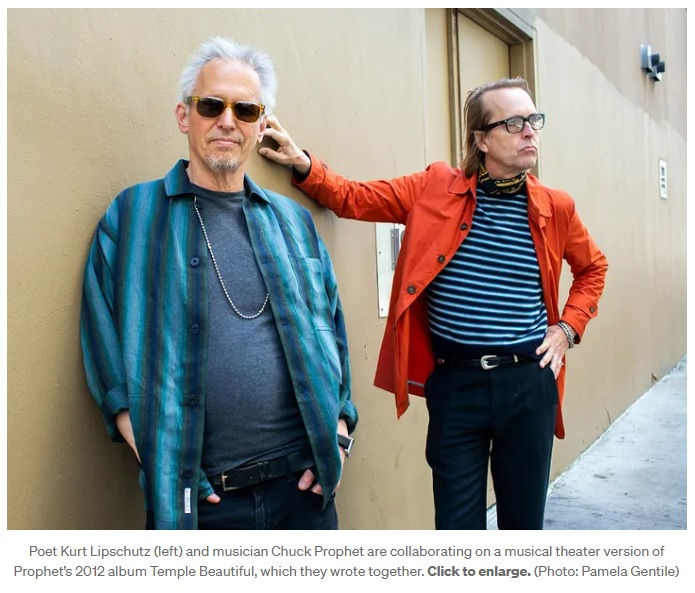
DG: At long last, let’s talk about what Chuck Prophet. When did you first meet? How did the long, fruitful collaboration start?
KL: We met in 1990, at a little club called the Albion, long since deceased. It’s been 35 years now, though we didn’t talk for 10 of those years. It must have been his fault, right?
DG: You have written more than a hundred songs together. Do you remember the first and what do you think of it?
KL: It was called “Savannah,” and was about a woman. We wrote it with Bone Cootes. I found the name Savannah in an ad for a porn star. I still like the song, slight as it is, but I’m a pushover. Except when I’m not. I don’t think Chuck would ever play it again, even with a gun to his head.
DG: To what extent were there creative disagreements and did they tend to increase or decrease as the collaboration continued?
KL: We’re older now, and Chuck has had some serious health issues, that he’s dealing with with grace. He’s still getting out on the road, traveling in a van, which I could never do. I don’t have the bladder for it. Anyway, we never really butted heads seriously about songs. It was more personal stuff. It helps that I’m probably his biggest fan. I like to think he’s pleased with what I bring into the room.
DG: What was the last song you wrote together?
KL: "Outlaws on the Late Show." Another one is called "Red Balloons." I hope they make the next album.
DG: What are some Chuck Prophet songs you like that you didn’t co-write?
KL: “You Did.” Damn, I wish I had some of the publishing money on that one. “No Other Love.” “Till You Came Along.” There’s a lot of them, but that will have to do.
DG: If you had the opportunity to master an instrument and contribute also musically to the band, which would you choose and why?
KL: I have no interest in performing with a band, but I sure do wish I’d stayed with the guitar—I had zero aptitude—so I could play and “sing” some of the songs I’ve co-written.
DG: What does the future hold? Any New Year’s resolutions?
KL: I’m beyond New Year’s resolutions. Besides, as you know I’ve been slower than the second coming of Christ in completing this interview and it’s practically next year by now. I’m hoping for a new Chuck Prophet release and that we can finally get our play, Temple Beautiful: The Musical on the boards. I’m also working on various collaborations with poet Jon Cone, including An Acceleration & A Calm, just out from above/ground press, based in Ottawa and run by that windmill of perpetual energy, rob mclennan. And maybe, just maybe, an outfit with actual distribution will be unhinged enough to pick up and publish my New and Selected Poems. Fat chance!
Author Bio:
K.Lipschutz (formerly klipschutz) is the pen name of Kurt Lipschutz. First fruits: The Erection of Scaffolding for the Re-Painting of Heaven by the Lowest Bidder (o.p.). Upon publication of Premeditations, he was shocked to discover that he has seven collections. He has co-written approximately 100 songs released by Chuck Prophet, including eight tunes on Wake the Dead (2024). Between 2014 and 2017, along with Jeremy Gaulke, he edited the collectible minimag Four by Two. (A complete set of twelve issues resides in the Special Collections Library at U.C. Berkeley.) K.Lipschutz lives in downtown S.F. with Colette Jappy, two cats, and the new kid in town, Dante the Inferno.


Comments