
León Salvatierra: California Poets Part 11, Three Poems
Updated: Oct 9
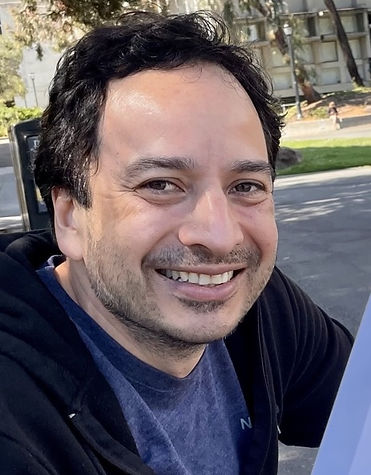
León Salvatierra
October 20th, 2026
California Poets: Part XI
León Salvatierra
Three Poems
Nica in LA
(when I don’t think of the city)
I
I don’t think of downtown traffic
a thousand red lights between us
back and forth
from Willow Street to Sylmar—
barriers strung across the city
testing the desire in our flesh
II
I don’t recall the immigration court
the clock inching forward
on tortoise limbs
in Room 4330
palms damp on our knees
waiting for judgment
from a black robe
six more months
Your hand closed on mine—
my voice cracked
at the Sentence
III
The riots don’t haunt me anymore
we fled Florence and Normandie
as flames raged
like red devils beating on
building after building—
helpless angels
their wings hardened in concrete
against fiery tongues
(at the epicenter
Simi Valley’s court
untouched white blinds remained)
By sundown we entered paradise—
a food court
an Orange County mall
White couples rushing
to Highway to Hell
You and I alone
stayed longer than expected
in Panda Express
the manager put free food
into our hands
IV
I don’t think of our steps on Venice Beach
the break we stole from work
the letter you slipped into my bag
you whispered
don’t open it yet
giants swelling their arms with iron
a woman tapping her tarot cards
your gaze
fixed on an Adonis
lifting dumbbells
nailed
naked to the cross
V
Your letter
slowed my blood
your reason for returning—
home where hope
had always fallen
like young bodies rising against dictators
the country we call
our Hell
I Became a Man the Day Selena Was Killed
(Los Angeles, mid-1990s)
I had just finished high school and was trying to find full-time work. I walked into Music Plus looking for a job application and found a line expanding and contracting like an accordion around the block.
People of all ages were waiting—children clutching posters, teenagers in neon windbreakers and high-tops, older couples holding plastic bags with CDs. I asked what was happening.
A woman shouted, Selena!
At the time, I didn’t really know her music. I knew of her—maybe from conversations where people talked about her being a Latina star.
I spotted a familiar face from hallways and homeroom. He waved me over, two posters in his hands. Do me a favor, man, he said. They’re only letting her sign one per person. Get this one signed for my sister.
I hesitated—I still wanted to ask about the job application—this place gets busy, there could be a job, I thought—but I joined the line.
The air smelled of hairspray, sweat, and perfume. The girl in front of me kept retouching her lipstick in a compact mirror. Behind us, two men debated whether Tejano was just a kind of cumbia. Near the entrance, a woman told her daughter to go to the payphone outside to call her tía Matilde—Tell her to come get a poster signed.
When it was finally my turn, I stumbled forward, feeling the line in its accordion expansion, the whole crowd breathing on my back—and there she was: Selena.
Smiling, radiant—
a kind of light that ignited my memory back to Xochitl,
my first adolescent love
She looked up as I handed her the poster.
You look familiar, I said.
She smiled again, Oh yeah? People say that a lot.
Honestly, I said, I think I’ve seen you before.
Where? she asked, her voice lilting, amused.
In Guatemala, years ago.
She broke into laughter—
that open, vibrant laughter that seemed to reach the whole store, expand into the streets, maybe even the entire city. Turning to the woman beside her, still laughing, she said,
I think I like this man!
The woman didn’t laugh.
Then she handed me the signed poster.
I don’t remember how much time had passed when I saw her face again on television.
Selena Quintanilla shot dead in Corpus Christi.
The camera showed the Days Inn motel, then moved to the same woman sitting beside her—
Yolanda Saldívar—her bodyguard, her killer.
It didn’t strike me until that moment:
Selena was the first woman
who ever called me
a man.
My Neighbor
a ritual dance around a center
in which a mighty will stands paralyzed.
—Rainer Maria Rilke
A noise arises from a dark corner
His ears perk
a rhythmic twitch on the tail
He leaps through an open window
after prey
He tires in seconds
Many birds have landed on his porch
and left the scene unscratched
Overweight he sighs
opens his mouth
devours pâté
climbs back to his sumptuous couch
onto his owner’s lap
The hands that rub his neck
burden his fur
a nightmare
Anyone would believe night’s laziness
seeps through his pupils
in his dream
he hunts across endless savannahs
The TV illuminates his eyes
Snaps him awake
His gaze fixes on the neck of his owner
the pulse beats unseen
Unblinking
he presses his claws into the denim
fur puffs
legs spring
the artery
flowing full
beautiful
it would be to kill
Author Bio:
León Salvatierra is a Nicaraguan poet and the author of To the North/Al norte (University of Nevada Press, 2022). His work appears in Here to Stay, Paterson Literary Review, Poetry, The Best American Poetry, and elsewhere. He teaches in the Chicana/o Studies Department at UC Davis.


Comments