
Murray Silverstein: California Poets Part 10, Five Poems
Updated: Jun 30
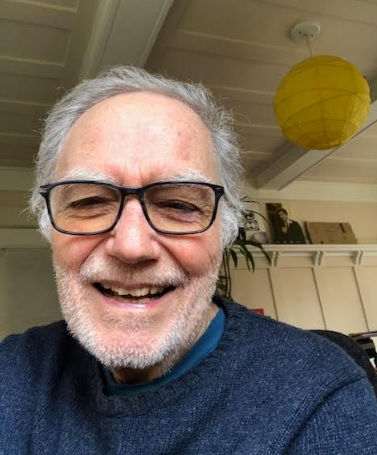
Murray Silverstein
April 2nd, 2026
California Poets: Part X
Murray Silverstein
Five Poems
A VISIT WITH A DYING FRIEND
for Max Jacobson
1
Recent work. Nude model, two-minute poses
with charcoal sticks and powder. “Life drawing,”
he says, husky voice. We’re sitting together
on his couch, turning the pages of his sketch book.
I pause to study one. The deep blacks, a cloudy smudge
of gray gives way to one quick contour line. Elegant.
“That one’s crap,” he says, “turn…”
and a few days later he’s dead.
But a few weeks later he’s back,
eyes open, stretched out on the floor of my study.
I stumble, trying to step around him as anxiously I prepare
for a talk I’m to give, but on what and to whom I’ve no idea.
And, worse, I’m to be there soon, the audience is waiting.
But where’s the hall, and what did I do with my notes?
Rising on one elbow, “I can help,”
he whispers. “Let me show you how it’s done.”
2
You were cremated. Simple Buddhist ceremony
Helen arranged at Chapel of the Chimes
that Julia Morgan we admired, its stately colonnade
marking the end of the road.
But no. Again you came back. This time
we’re in the old office—the building’s been sold—
and the new owner’s asking questions, wants me
to climb a ladder, examine an old brick flue.
What on earth was it for, he wants to know,
there was no fireplace. “It vented our old furnace,”
I explain, “a converted coal burner, useless thing,
warming only those who stood close. Max,”
I say (you’re standing beside me now), “why
did we put up with it, the pilot always going out?”
“No,” you say, “that’s wrong. It worked just fine.
I loved the heat, the jets of gulping flame.”
3. “See, they return, and bring us with them.”
` —T.S. Eliot, “Little Gidding”
Woke this morning, the bed disheveled, not with a dream but with words on my mind,
the title of a book I loved, In Dreams Begin Responsibilities.
Jacobson/Silverstein Architects. We were.
And teased ourselves into thinking there’s life in a well-made thing.
Find now, uncoupled, there’s nothing, that nothing’s the engine of life wanting more.
Called to account in dreams, it’s the dead that do the dreaming. Our loyal dead.
And what they dream is us.
THE REFINING FLAME
When he’s near the top of Mt. Purgatory, pilgrim Dante encounters the soul of an old friend, a fellow poet, and, to comfort his dead friend, he says, “So long as words endure, your poems will make precious the ink in which they’re written.”
“Kind of you to say,” the dead friend replies, “but no, that’s wrong…” and points to a soul up ahead, about to enter a wall of flame. “That one over there, he’s the real deal: If it’s a poetry of love you seek, go talk to him.”
Purgatorio, Canto 26, 136-148, a translation:
I inch forward toward the one pointed out to me,
tell him I’m eager to know his name.
“I hear kindness in your question,”
he says without hesitation, “which assures me
I’ve nothing to hide: I’m the soul of the troubadour,
Arnaut Daniel, dead for almost a hundred years.
You read my poems when you were a boy.
Here on the mountain I’ve come to see
the madness of my ways, but, too, the joy of release
that lies ahead. If, as it seems, you’re still alive,
may I ask that you remember me,
tell of how I suffered?”
Then he stepped into the fire
and vanished in the refining flame.
OLD MAN, OLDER HOUSE
After Patrick Kavanagh
We borrowed the dough to make the down
on the shingled house on Harwood,
the dormer, the gate backed up to a creek,
the rickety porch, the redwood….
While scraping and painting, settling in—
the kids were one and almost four—
Can I look around, I was born here?
an old woman came to the door.
Slowly she paced the rooms, the yard,
Here were the chickens, Gertie, my hen…
till now it’s me who names lost names—
Jerry, the Stevens, the Colliers, Ben—
until a world comes into view,
complete with Nancy’s cat and dog,
and the god of imagination
rising from an Oakland fog.
WHAT TIME IS IT?
New Years Day 2026, for Du Fu and Albert Einstein
When we speed up—as, in a flash, Albert, you saw—time slows.
It’s what, Du Fu, you discovered considering the moon:
the speed of light requires night. I stare, too, same moon,
same light, and think we’re stones dropped into a well,
the deep-dark well of time, and though the earth is spinning,
the well is standing still; it’s us does all the falling.
Those at the top listening for us to splash,
they’re our dead. To them the well seems bottomless,
we’re taking forever, they think, to fall.
To us falling, no: as science sprinkles the minutes
on us, music the tempo of space between, our days
are speeding up. Yesterday near noon, “Noon,”
I said, rounding up, to a woman on the street.
“Do you know,” she’d asked, “what time it is?”
“Thanks,” she said, pleased. Because isn’t it always a time?
But what’s this it of which you speak—it’s Du Fu
and Albert, in chorus now—and hope to measure
with your stanzas, your broken lines?
THE FOREVER TREE
Tiny, pink, invisible almost, the buds
on the redbud: you stare
at bare branches, and there they suddenly are!
Later, popped and petal’d, the petals
more pink than the buds—the buds
were more a magenta—the tree’s
an offering now: beauty sprung from trauma—
the neighbors’ willow, a year ago,
fell and took half of it down.
Then begins a sloughing of buds,
petals unfold, edges trimmed
in creamy white: the patch of blue
they open to paradise on the cheap,
the meaningful forever
we’re always carping doesn’t exist,
or does but we have to go.
No. This patch of forever’s forever,
let yourself in, back in.
Interview
June 29th, 2026
California Poets Interview Series:
Murray Silverstein, Poet, Architect
interviewed by David Garyan
DG: Having lived in Ravenna for two years, I was fascinated by your Dante-inspired poems, in particular Last Entry. The connection between Dante’s poem and the construction of Brunelleschi’s dome is fascinating, especially in how the poet describes his descent into hell, qua giù di giro in giro, which is juxtaposed with heavenly construction—from an architectural point of view, likewise, circle by circle. Indeed, one doesn’t have to be a genius to notice how the language of architecture is used when we talk about constructing metaphors, lines, and meaning—these exist in all writing, but especially so in verse where the visual element is a natural component of the meaning of itself. As one of the few architects who writes poetry—and the only one I know who does—could you talk a bit more about the connection between the two disciplines, and how visualizing concrete structures has influenced you in shaping the metaphorical ones?
MS: In my first book, Any Old Wolf, there's a poem called "Two Loves" that begins in the following way: “Architecture. Poetry. And each the envy of each….”
I began reading poetry, and to be enchanted by it, in my teens. When I became an architect, I felt a rivalry develop between the two arts: poems wanted to be spaces—spaces that worked their magic with silence, while certain buildings, speaking in the spatial language of sun, shadow, open, closed, movement and rest, had the desire to speak and be poems.
After each the envy of each, “Two Loves” goes on: architecture, for the lyric or lament / that occupies time, sings of its passing / but (how does it do that?) does not pass, / and poems for spaces (you’ve been in some), rooms that unpack the superfluous said. / To be a place! the poem cries, and twizzles itself / across the plane; as even the humblest, dumbest shed / thinks it could tell, if it could tell, of wind and graves / and wanderings, how bodies are the dream of home.
It can be useful, this envy. Architects ask what a space wants to say. Poets wonder what kind of place a poem wants to be.
There’s also a way in which the two arts act like antidotes to each other; as if each contains a kind of poison, for which the other is medicine. Buildings are expensive. They must meet budgets, follow complex codes, and be made by groups of folks—clients, engineers, planners, builders. The materials of poetry, however, are few, simple and cheap—paper, pencil, a mother tongue (given to you for free)! And you do the work in solitude, trying only to please your inner ear. But poems, I often feel, crave the silent materiality of buildings, and long to be places where you can just sit quietly and watch morning light come through the window.
DG: In fact, the term pattern language wasn’t invented by a linguist but by an architect, Christopher Alexander through the publication of the book A Pattern Language: Towns, Buildings, Construction, which you, in fact, co-wrote. Perhaps the most famous line is “most of the wonderful places of the world were not made by architects, but by the people.” Could you speak a bit more about working on this book with Alexander and the other authors, along with how the problem-problem solving concept has gone on to influence your poetry?
MS: Chris, Sara Ishikawa and myself—the senior authors of the book—invented the term “pattern language” around 1968. Chris had spoken of a “rule system” that was at the heart of great buildings, and as we three worked to understand and portray such a thing, we found that term clumsy, not able to capture the generative, creative power of the deep structure at the heart of languages, spoken and spatial. We can feel, intuitively, when a stream of words finds its right form, in both everyday speech and great poems; what, we asked, were the spatial patterns that govern certain places, buildings, cities, where a kind of organic order—a wholeness that feels both human and alive--has been achieved. It can be as simple as a bench placed under a tree, the way morning sun strikes a wall, or as complex as the great Brunelleschi dome. If we could elucidate such patterns for our pluralistic times, the kind of patterns which enabled indigenous builders to make “architecture without architects,” anyone, we imagined, could use them to make great places, beautiful buildings. We took seven years to write the book. It was completed in 1975, with co-authors Max Jacobson, Shlomo Angel and Ingrid King, and has been widely read, translated into several languages, become a best-seller for Oxford University Press.
About thirty-five years later, around the time my first book of poetry was published, I wrote for a conference a short essay reflecting on A Pattern Language. I saw it as a kind of poetry, a redress, it seemed to me, in the face of the inhuman mess that, with rare exceptions, our buildings and cities had become, were becoming … a kind of reparative vision, similar in spirit to Seamus Heaney’s idea of “the redress of poetry.” This essay, “O Rose Thou Art Sick,” took its title from the opening line of Blake’s great poem from his Songs of Experience.
DG: You discovered poetry much later and life, yet for the discipline we’re involved in that’s not necessarily a bad thing. Unlike in music and film, there are no child geniuses here, for verse, above all, is an experiential art. The old maxim—and I can’t remember who said it now—is that if you write poetry at twenty, you’re twenty years old, but if you write poetry at forty, you’re a poet. In that respect, you haven’t arrived late to the art—instead, you took a shortcut. And all this for a simple question: How did you discover this beautiful form of writing? Was it someone, something, or everything that brought you to it?
MS: Everything! I’ve been in love with poetry forever. A wonderful drama teacher, Miss Moody (Fairfax High, Los Angeles, 1960) got me reading Shakespeare, and encouraged me to memorize the “O what a rogue and peasant slave am I” soliloquy in Hamlet, and for that I am forever indebted. And there was an English teacher, too, whose name I fear I’ve forgotten, who got us to read John Keats, and these lines from the Grecian urn poem, where Keats speaks directly to the old urn, seemed to me the greatest thing ever:
When old age shall this generation waste, / Thou shalt remain, in midst of other woe / Than ours, a friend to man, to whom thou say'st, / "Beauty is truth, truth beauty,—that is all / Ye know on earth, and all ye need to know."
In Any Old Wolf, written in my 50s, there are poems dedicated to these two teachers, “I, Cobweb,” for Miss Moody, and “Mr. O’” for the Keats guy. In some ways, coming late to writing poetry as I have, it’s been a “return of the repressed.” Like meeting up late in life with a girlfriend you were crushed on in high school: she still looks pretty good, and, why not?, you start a fling, a romance, that—I’m 82 now—carries you straight into and through old age. Today, writing in the Time of Trump, and thinking of poetry, I’m comforted—revising Keats—to think ‘when old age my generation wastes / thou shalt remain, in midst of other woes / than ours, a friend to all, to whom thou say’st…etc.’ You get the drift.
DG: In your latest collection, Red Studio, there’s a poem I absolutely admire called “Love at the Cardiologist’s.” The juxtaposition between the heart in a medical sense and the romantic one is fascinating in how it ultimately revolves around great Polish poets, but also figures like Dante, yet the work is written in prose form, adding further contrast. Could you talk a bit more about the composition of this piece? How much editing was involved in it? And was that one of the first poems you wrote for the collection or among the latter ones?
MS: I wrote that right after a visit to the cardiologist’s office; a prose note to describe exactly what took place! I was enthralled by the experience on top of being super-anxious, of course. (I think I added a couple of authors to the second part of the poem but otherwise it’s word for word what happened). I set that prose piece aside and it took me a few years before I came to see it as central to the first section of Red Studio, part of a sequence arising from a medical adventure for which poetry became, in Syzmborska’s wonderful phrase, a “saving bannister.”
I remember, about ten years ago, reading the poem for the first time at a Valentine’s Day reading in an Oakland bookstore, and an old guy came up to me afterwards and said, “Exactly. I know those gals…I go to that cardiologist too!”
DG: There are also other prose poems in the book. I’m curious to know if these pieces always start out as such or if there are some that also began with traditional lines and later became what they are?
MS: All of the above. Teasing the final form of a poem out of the initial thoughts, phrases, feelings that begin a poem, is, for me, half the fun. In architecture, the client’s program, the site, functional requirements, all suggest formal possibilities, but once a form comes into view it make its demands as well. I find something similar goes on writing poems. As what you feel to be the right form for a poem emerges from the drafts, it can suggest new, unexpected content, changes in voice and tone. It’s a twisty, mysterious and compelling process, finding form. I love being in the middle of a work, not knowing where it’s going, but suspecting that, trusting that, it’s going somewhere good.
DG: The choice of Red Studio as a title isn’t merely a placeholder as L’Atelier rouge is a famous painting by Matisse, and a poem in his honor does appear in the collection. Because of how the French language works, the noun necessitates the article, making it The Red Studio. English, being free of these constraints, allows, one might argue, for greater expression, but also greater ambiguity, which isn’t entirely bad for poetry. There’s a big difference between red studio and the red studio—of the former we imply many; of the latter we specify just one. Was the article’s removal a thematic concern for inclusivity or did you also have other reasons for choosing to do so?
MS: Fascinated by the Matisse painting (which I came to online, I’ve never seen the real thing), I wrote the poem relatively quickly. And had the vague thought it might be a title poem, announcing a kind of psychological space within which poetry is created. But it was Carolyn Miller, the editor at Sixteen Rivers Press who helped me find the structure for the book as a whole, who suggested placing the poem about the painting, The Red Studio, at the end of the first section, and then dropping the article for the book’s title. This seemed exactly right, as I wanted the overall title, inspired by the painting, to suggest the kind of place, a frame of mind, if you like, within which one does the work, the heart-work of making and reading poems. There is a moment in the poem where the narrator lifts the goblet portrayed in the painting to his lips, and finds…it’s empty / of all but color, / the astonishing blinding red / that all but devours the room. It’s mystifying / terrifying even, learning / to give and receive love. That moment, for me, is more or less the heart of the book.
DG: Speaking of inclusivity, the collection never loses its element of cohesion. If there’s too much of the former, the latter seems to suffer. Yet there’s so much thematic connection going on in the book that a reader never questions why there’s a translation of Dante’s canto from The Divine Comedy in it. The chosen passage describes the setting or rising sun, creating a striking association that red has for the poet, and when coupled with the concept of the red thread of fate as not only a textual metaphor but a symbol of fate itself, so does the collection begin its descent to the end. I’d hence like to ask how much time and energy you devoted, specifically to arranging the poems so they could read as a kind of filo rosso del destino?
MS: What an interesting question. And, again, I have to thank Carolyn Miller for helping me find the overall order, the three sections, and arranging the poems within each section. And, like I said about form above, once the overall order came into view, it suggested edits and in a few cases new poems. “Abandoned Epigraph,” for example, changed from a lineated form to become the prose poem which opens the book, announcing the theme of discovery within a red studio-type space. Poems can turn on you, friends, it says, mid-way through, opening the door, I hope, for a reader to make similar discoveries along the way.
DG: The cover is striking, yet simple. Was it something you envisioned from the beginning or did you go back and forth between a few different options?
MS: I didn’t want a specific image for the cover. Only color, Matisse’s venetian red, the warm, earthy shade of red that Editor Carolyn Miller—who also designed the book—found and employed so beautifully. I couldn’t be more pleased with the way Sixteen Rivers Press, a cooperative poetry publishing work collective—published the book.
DG: I’d like to ask about space in relation to where you work. An architect has his studio, or, at least, his desk because of the specific materials and tasks involved in such work. A poet, however, can (or at least can have the capacity) to write anywhere. Do you follow an architect’s approach when it comes to your writing space or do you sit wherever inspiration is waiting?
MS: I jot down notes all over the place, sometimes just mental notes, but drafting and redrafting is all done at one desk in my home, sitting beside a north facing window looking out into a backyard garden that my wife has created over the last 25-30 years; approximately, I suddenly realize, the same span of time in which I turned to writing poems, she turned to creating this garden!
DG: Who are poets you turn to consistently for inspiration?
MS: So many. I’m reluctant to name just a few for fear of offending beloved authors! I like to listen, to think about, the conversation that I hear going on between poets, between Heaney and Milosz, for example, or between Dickinson and Whitman, Yeats and Lorca, Dante and Shakespeare, Stevens and Keats, and on and on. The space between! I’m working now on a fantasy poem, a kind of book club paradiso, where, after their deaths, poets can read and learn from folks who came after them. Virgil, for example, can read Blake; Dante reads Allen Ginsberg’s Kaddish, and gets new ideas for the Commedia …. And then this morning, out of the blue, I came upon poems by Adrienne Rich and Mark Doty which knocked my socks off …. So who knows! One poem leads to another. May it all go on and on ….
DG: What are you working on at the moment?
MS: I have a new manuscript, nearly done, the current title (thanks to Lynne Knight), Loss the Way In, Loss the Way Out. It’s in four sections. Growing up in a Jewish neighborhood in post-world war II Los Angeles, becoming an architect, climbing Mt. Purgatorio with Dante, a moment, on the terrace of anger, with Primo Levi in Auschwitz; overall a search for hope ending up, in my 80s, in my own post-secular backyard.
In its current form the book concludes with a line from Joyce: Near the end of Ulysses, as Bloom and Stephen say goodbye, the heaventree of stars hung with humid night blue fruit.
Thanks for your questions, David. It’s been a pleasure to respond.
Author Bio:
Murray Silverstein’s third book of poems, Red Studio, appeared Spring 2024 from Sixteen Rivers Press. He has been published in RATTLE, The Brooklyn Review, Cape Rock Poetry, Spillway, Poetry East, West Marin Review, RUNES, Nimrod, Connecticut Review, ZYZZYVA, Elysian Fields Quarterly, The MacGuffin, Pembroke Magazine, among others. He has authored two previous books of poetry, Master of Leaves (2014) and Any Old Wolf (2007), the latter of which received Independent Publisher’s Bronze Medal for Poetry in 2006. Silverstein is the senior editor of the anthology America, We Call Your Name: Poems of Resistance and Resilience (2018), winner of the Independent Publisher’s Silver Medal for Anthologies in 2017. All were published by Sixteen Rivers Press. A retired architect, Silverstein co-authored four books about architecture including A Pattern Language (Oxford University Press) and Patterns of Home (The Taunton Press), and lives in Oakland, California.


Comments