
Victoria Chang: California Poets Part 11, Five Poems
Updated: 4 days ago
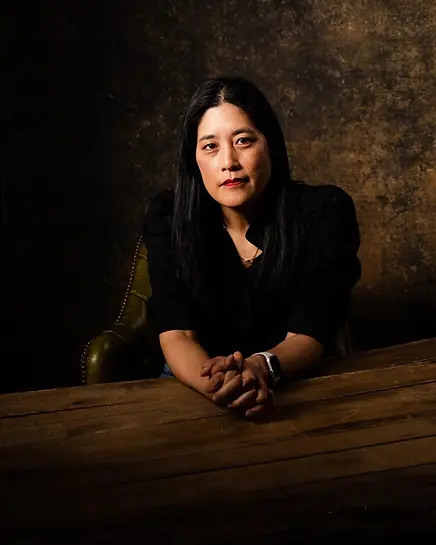
Victoria Chang (photo by Jay L. Clendenin)
October 20th, 2026
California Poets: Part XI
Victoria Chang
Five Poems
Language
Language—died, brilliant and beautiful
on August 1, 2009 at 2:46 p.m. Lover
of raising his hand, language lived
a full life of questioning. His favorite
was twisting what others said. His
favorite was to write the world in black
and white and then watch people try
and read the words in color. Letters
used to skim my father’s brain before
they let go. Now his words are blind.
Are pleated. Are the dispatcher, the
dispatches, and the receiver. When
my mother was dying, I made everyone
stand around the bed for what would
be the last group photo. Some of us
even smiled. Because dying lasts
forever until it stops. Someone said,
Take a few. Someone said, Say
cheese. Someone said, Thank you.
Language fails us. In the way that
breaking an arm means an arm’s bone
can break but the arm itself can’t break
off unless sawed or cut. My mother
couldn’t speak but her eyes were the
only ones that were wide open.
Previously published in Obit, 2020, Copper Canyon Press
Gift
Is silence a gift?
I can’t hear my bones shrinking,
the lemon turning yellow.
The flag is louder
than my memories. How I
wish time were a wooden wheel.
Previously published in The Trees Witness Everything, 2022, Copper Canyon Press
How Alone Barbie Chang’s Mother
How alone Barbie Chang’s mother
must have felt doing
nothing but dying her mother actually
stopped dying her hair
in January stopped being an actuary
for her money she
must have known her time was limited
did the diseased birch
tree know they were going to cut it down
how quickly the air
around it filled in the space it does no
good to know a mother’s
face who would have known that a
mother’s face could
be erased too at some point we are all
eliminated from this
earth at some point most of us give birth
at some point we lose
a mother at some point we are all
disappointments who
can’t possibly care for others when
our mothers die we
are all lost and there are no words for
it some want to
name us as grieving others wrongly
name us heroes
Previously published in Barbie Chang, 2017, Copper Canyon Press
Central Park
The moon in the painting came through the branches
like applause. The tree trunks looked just like the
stones, the stairs, and the people. I, too, had nowhere to
move. I was anxious about the threshold. That if I went
too close to the hole in the ground, the search would
end. Alice Neel said, When you’re an artist, you’re
searching for freedom . . . in fact, art can be called the
search. I want to ask Neel if something can be called a
search if the object isn’t reachable? What if language is
glass blown but not made of glass. How do we live as
artists without dislocating language? Without viewing
the present as an errand of death? Maybe the search
Neel refers to is just seeing. The painting is what has
outlived seeing. Maybe the seeing itself is freedom, for
the looker and the object. No matter how divided. After
fifty years of separation, I now try to see everything
together, in the present—all the white hotel sheets of
the foreground, the dead people in the background,
the birds flying in airports in the middleground. This way, seeing
and salvation stop rejecting each other.
This way, everything is a dome versus a line. And everything
gets recognition at once.
Previously published in the Spring Issue (2024) of the Washington Square Review
On a Clear Day
—after Agnes Martin’s Untitled from On a Clear Day (1973)
On a clear day, the horses disappeared.
All that was left were the apples they had been fed.
The apples were strewn across the field and
had become rectangles.
When people found them, they still gathered
and ate them.
The people who hunched over their
apples were far away, over there.
But the sounds of their chewing were
over here.
On a clear day, all the sounds fit into the boxes.
On any clear day, all my thinking fits
into boxes that can’t be opened.
What if our thinking was never meant to
come out?
What if our thinking only remains thinking
within boxes?
When out, they become weapons, take
on different shapes with sharp points.
Today, there is no shortage of thinking but
all the thinking is divided into portions.
Today, I am hungry but all the portions are gone,
there are only forty eight.
On some clear days, there are only forty eight birds
and forty eight people and forty eight houses.
And forty eight wars. And forty eight apples.
I keep counting grids. But no matter how I try,
I still get six dead Asian women who fit into
forty eight boxes.
All night, my thoughts are shaped
like birds.
In the morning, I lean in closer to the mirror and
someone has drawn lines across my face.
I realize failure consists of both the outline and
the outlin
I realize the lines have not abandoned us,
but just our emptiness inside.
Previously published in With My Back to the World, 2024, Corsair
Interview
October 20th
California Poets Interview Series:
Victoria Chang, Poet, Writer, Editor, Professor
interviewed by David Garyan
DG: I’d like to start with your connection to the Golden State, where you had and continue to have great success as a poet—a California Book Award for The Boss in 2014, and being a finalist for the same prize in 2025, for With My Back to the World. Yet it’s also here that you decided to pursue an MBA at Stanford, before receiving an MFA from Warren Wilson College. Could you speak a bit about how California influenced your writing and to what extent the transition to the MFA changed the way you’d been working so far?
VC: I’ve spent most of my life in two states: Michigan and California. I also think that those two landscapes influence my writing the most. Most of my recent poetry takes place in California. A lot of my children’s books take place in Michigan.
I don’t really think of the MFA as a transition, so much as just part of the larger journey as a creative person. It was nice to study poetry for two years very seriously. But I studied a lot of poetry in high school and college as well.
DG: Teaching has been an important part of your career and you currently serve as the Bourne Chair in Poetry at Georgia Tech. How would you describe your teaching approach, the challenges and rewards that come with them, and how do these influence your own creativity?
VC: Teaching right now is the “career.” Not poetry or writing. That’s not a career for me and I actually never use that word to describe poetry writing for me at least.
Teaching is very difficult and I work very hard at it and pedagogy in general, staying on top of new ways of thinking and instruction. My pedagogical approach borrows from community organizers, yoga practices, wellness practices, and social justice practices. I’m always learning how to be a better teacher of poetry of course, but also thinking of new ways to engage the students. In the age of AI, I’m totally revamping my syllabus this semester.
DG: It’s been your great fortune to have incredible success. I’m always curious to know how poets view their first book in relation to their latest one. Do you see a grand trajectory connecting them both or has each collection been a sort of microcosm of what you felt at the time?
VC: To be a bit repetitive, I don’t think of my writing life as a career or in terms of typical measurements of “success.” It’s an art and a way of living for me, a practice. I’m also not thinking about my own trajectory as a writer. I just enjoy the process so I sit down and begin, spending a lot of my spare time, probably almost all of it, writing. Whatever I’m thinking about at the moment and when I happen to be sitting—that's what I write toward. Naturally, if I’m writing, that work might reflect my life at that time.
DG: You have a fairly good command of Mandarin. Each language is its own microcosm, given the number of words that are either so difficult to translate or entirely untranslatable. Given that Chinese is a tonal language and English is not, how much of an impact does your knowledge of the former have on the way you approach the composition of a poem from a structural point of view?
VC: Mandarin was my first language in the home, but the minute I started attending school, English became dominant. That said, my mother never really spoke English to me and I also loved/love studying Mandarin so I think I’m decent at speaking, meaning I can get by, but I understand a lot more. I don’t really know how the two relate to each other, but I don’t really think about it. Both languages are in my head all day long, as are both cultures.
DG: In 2021, you published Dear Memory, a memoir in the form of letters. Identity, memory, and trauma are all part of the work and they reverberate across generations. Poetry can be autobiographical, but its universal nature tends to place a distance between the poet and her work. Did you choose to write the memoir to liberate yourself, in some ways, from the I of the poem’s speaker in relation to your own story?
VC: I’m not sure we choose what to write, or at least I don’t. I think the subject often chooses me. Everything I write tends to be organic. I just go where I am called.
DG: I love the juxtaposition of the title With My Back to the World in relation to the themes contained within. The collection is based around the artwork of Agnes Martin. When looking at a piece of art, we naturally face it, and in that sense, by doing so, turn away from the world—yet only insofar as to try and give it meaning. Could you talk a bit about the writing process for this particular collection and how, if at all, your relationship to art changed as a result?
VC: This collection started from a commission from the MoMA. I had trouble selecting a piece from their vast collection, so I switched my thinking, focusing on an artist I didn’t understand very well, and that was Agnes Martin. Once I wrote one poem, I felt called to write another and then another. Suddenly, I had a whole collection of poems.
I’ve always enjoyed looking at art so I’m not sure this experience was much different than looking at art all the time, which I do. I’ve also written many ekphrastic poems in the past, but this was the first time I engaged with an artist for so long and so extensively.
DG: Has your revision process changed over the years as you gained greater confidence in your writing?
VC: I think every manuscript I’m working on requires new and different demands in terms of revision. Of course, I have gained skills as a writer and in terms of revision, but hopefully, every new thing is just that, new. I enjoy challenging myself in new ways so every manuscript feels challenging and fun.
DG: All of your work has brought in personal elements to some extent but it’s Tree of Knowledge that really most takes on the topic of the body. As you stated in another interview: “I’m struck by how hard it is to find the word menopause in a poem.” At the same time, there’s a long piece called “Eureka” that deals with the banishment of Chinese-Americans from the city in the 19th-century. I immediately made the connection between the aging of the body and the so-called aging of history that often leads to outright forgetting. Would it be right to say that this collection was an attempt to reclaim in time what has so far been denied—both to women and to Chinese-Americans?
VC: I’m not sure Tree of Knowledge is trying to “reclaim” anything. That word feels far too active to me in terms of composing poetry. I think this effort itself is a matter of bringing your voice from the inside to the outside, which is a form of agency, of course. But I don’t really try to do anything while I’m writing. I actually try to avoid thinking about active verbs as I’m in the crafting process. This might sound strange and it actually feels hard to explain, but for me, the creative act of putting pen to paper is the exact opposite of reclaiming. It’s actually letting go so that the ego disappears entirely, so that (hopefully), I am lifted and taken along by some kind of spirit.
DG: What book have you recently read that inspired you?
VC: I’ve been writing poems on Caspar David Friedrich and an artist friend recommended this amazing book to me called Caspar David Friedrich and the Subject of Landscape by Joseph Leo Koerner. It’s so good, but I’m also really interested in Friedrich and also love reading books like that. It’s probably not everyone’s cup of tea as it can be academic.
DG: What are you working on at the moment?
VC: A new manuscript of poems. I don’t usually say much about what I’m working on since it’s still relatively new and I’m still in the process of listening to its shape.
Author Bio:
Victoria Chang (she/her) is the author of With My Back to the World (Farrar, Straus & Giroux, 2024), The Trees Witness Everything (Copper Canyon Press, 2022); the nonfiction book, Dear Memory: Letters on Writing, Silence, and Grief (Milkweed Editions, 2021); and Obit (Copper Canyon Press, 2020), which won the Los Angeles Times Book Prize, the Anisfield-Wolf Book Award in Poetry, and the PEN/Voelcker Award. She has received a Guggenheim Fellowship and the Chowdhury Prize in Literature. She is the Bourne Chair in Poetry at Georgia Tech and the Director of Poetry@Tech.


Comments